Distributed coordination
Divide work and coordination across nodes to limit reliance on a single controller. Trade-offs include synchronization, network overhead, and consistency.
Technology / Research & development
Our primary mission is developing proprietary decentralized computing and renewable-energy infrastructure technologies.
Development direction
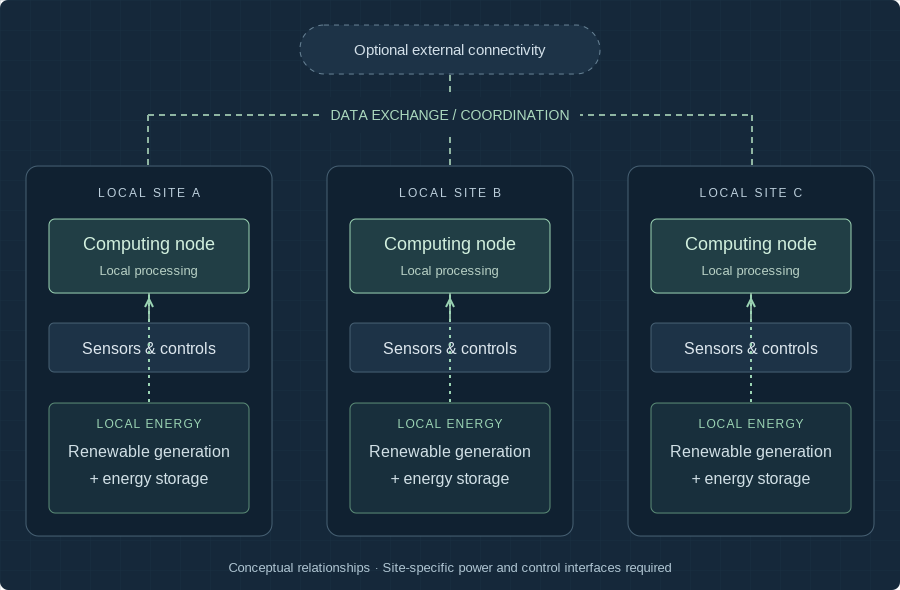
We investigate systems in which computing and local energy resources work together without relying on one central point for every decision.
Distributed computing divides work across nodes. Decentralized architectures distribute coordination and authority as well. Neither approach removes the need to manage consistency, security, or operational complexity.
The architecture below illustrates design objectives. It is not evidence of commercial deployment, measured performance, or independent validation.
Engineering principles
Divide work and coordination across nodes to limit reliance on a single controller. Trade-offs include synchronization, network overhead, and consistency.
Process selected data locally to support time-sensitive decisions and limit unnecessary data movement. Workload placement depends on resources and application needs.
Explore redundancy, fault isolation, and recovery so a component failure need not stop the whole system. Redundancy must be balanced against cost and energy use.
Investigate how variable local generation could inform computing schedules and energy demand. Renewable input depends on site conditions and system design.
Consider storage, power conversion, and microgrid coordination as part of the architecture. Compatibility requires interface design and project-specific testing.
Design for selected local functions to continue during connectivity interruptions or constrained power. Actual continuity depends on energy reserves, loads, and validation.
Development, clearly defined
Resilience, local autonomy, and energy efficiency guide our development. We are not publishing independently validated benchmarks or claiming general compatibility, uninterrupted operation, or a commercially available infrastructure platform.
Current commercial offerings are applied engineering services, described separately.
View current engineering servicesStart a conversation
Tell us what you need to measure, connect, or control.